These are some failed slogans with Subversion that we came up with on a CollabNet offsite many moons ago. You can see why we rejected them...
A place for your stuff.c.
Like a mom for your data.
If you kept your car keys in here, you'd never lose them.
Why recycle when you can save everything.
We'll watch your code while you sleep.
Subversion : code :: bank : money
It's like CVS, except for the sucking bit...
If your data lived here, you'd be home by now.
Don't remember how bad your code was 4 years ago? We do.
Those who forget the past are condemned to rewrite it.
Developing snapshots faster than that PI tailing you...
Like a photo album for your code's childhood.
It's Jims's world, we're just living in it.
As American as baseball and apple pie.... mmmm...... pie......
Apr 20, 2007


Apr 15, 2007
It's Made of Meat!
If you've ever talked to me for more than 20 minutes, you've probably heard me say "It's made of meat, so it's good for you!". This quote comes from a spoof radio ad that I found on the internet circa 1996 (which is 134 years in internet time). After I first heard it, I downloaded it and listened to it a number of times, laughing uncontrollably--I can't explain why.
Somehow over the next few years, I lost my copy of it, and no amount of searching the net would turn it up, so I pretty much gave it up for lost until one day in 2001 when I was going through some old hard drives. I was just making sure that there wasn't anything valuable on them before I threw them away and I came across a file with the somewhat odd name meat.au (ogg format here). Sure enough, it was The Meat Ad.
The upside of this discovery is that I now have proof that I didn't just dream up this whole meat thing, even though I still can't explain why I find it funny. And when I visited the guys at skinnyCorp a few years ago, they gave me a Meat T-Shirt.
And yes, it's all meat. So it's good for you!
Somehow over the next few years, I lost my copy of it, and no amount of searching the net would turn it up, so I pretty much gave it up for lost until one day in 2001 when I was going through some old hard drives. I was just making sure that there wasn't anything valuable on them before I threw them away and I came across a file with the somewhat odd name meat.au (ogg format here). Sure enough, it was The Meat Ad.
The upside of this discovery is that I now have proof that I didn't just dream up this whole meat thing, even though I still can't explain why I find it funny. And when I visited the guys at skinnyCorp a few years ago, they gave me a Meat T-Shirt.
And yes, it's all meat. So it's good for you!
Apr 12, 2007
God Bless You, Mr. Vonnegut!
Kurt Vonnegut died tonight. He was my favorite author. So it goes.
All time is all time. It does not change. It does not lend itself to warnings or explanations. It simply is. Take it moment by moment, and you will find that we are all, as I've said before, bugs in amber.
-Kurt Vonnegut, Slaughterhouse Five
Apr 11, 2007
My Maps Rocks
Google Maps' newest feature, "My Maps" is totally awesome. Since I lived in Rome for three years, friends and family are always asking me where to go when they go to Rome. Now I can just point them at my map of places to see in Rome.
Mar 21, 2007
Dear Webmasters...
One way to get me to remember your website is to automatically resize my browser window when your site loads. The fact that my browser window--with the eleventy-seven tabs I have open--is now 720x800 on my 2600x1600 monitor ensures that I will never visit your site ever again.
Thanks,
-Fitz
Thanks,
-Fitz
Mar 19, 2007
Hans Rosling is a Genius
I'm a huge fan of visualizing data. You can show me piles of numbers and I'll just fall asleep, but Pretty Pictures--now that's what I'm talking about. If a picture is worth a thousand words, a good graph is worth a billion numbers.
Hans Rosling gave a talk at Ted that touches on the visual display of global statistics over time that had me riveted to my monitor. Watch it if you haven't already--it will be the best 19 minutes you spend all week:
Mar 7, 2007
The Top Ten Subversion Tips for CVS Users
This was published on ONLamp on 08/19/2004. The original should be here. I'm putting all of the articles I've recently published on here so that I'll have one place I can look for all of them
The primary mission of the Subversion project is to "provide a compelling replacement for CVS." One of its secondary missions is to provide a user interface similar to CVS's, so that switching to Subversion will be painless for CVS users.
So, if you learn Subversion's new features, you're ready to start using it, right?
Almost. Although the interfaces are similar, there are some important differences. Subversion has some features that CVS either lacks or offers differently; plus, there's the need to unlearn some of the bad habits that CVS has instilled in you.
With that, I give you the top ten Subversion tips for CVS users. The first six tips address bad CVS habits; the last four address good Subversion habits.
1. Use
In CVS, if you want to see what has changed in your working copy, odds are that you run
With Subversion, if you want to find out what you've modified, you run
Note that
Now, by default,
The first column remains the same, but the second shows the working revision of the item. The third and fourth columns show the revision in which the item last changed, and who changed it.
If you want to know which files will be updated the next time you run
You can see that the files that will be updated are marked with a
* Unless you pass CVS the -n switch.
** CVS has a
I've seen people spend hours in meetings working out the directory structure and file placement of a project they are preparing to create in their CVS repository--and anyone who's ever tried to move a directory or a file in CVS knows why: CVS doesn't allow you to move anything around in the repository!* With Subversion, you can move files and directories with wild abandon:
Now
You can even move files and directories on the server by using URLs:
That will immediately move
* Unless, of course, you shell into your repository and start moving and copying things around by hand, but this totally hoses your repository history.
In CVS, you have
You've created a tag of your main line of development (referred to as
In Subversion, tags and branches are just copied paths in the repository tree. By convention, tags live under
CVS has to modify each individual file that you tag in the repository; depending on the size of your repository, this could take a very long time. Subversion, on the other hand, needs only to copy a single directory node, which not only is really fast but also takes very little space in your repository--no matter how many files are involved in the branch or tag. The Subversion community calls 'em "cheap copies" for good reason!
You're not limited to tagging all files in the same revision in Subversion: If you need to make a "mixed-revision" tag or branch, you can always copy a working copy to a URL:
See Branching and Merging for an extensive description of how to branch and tag.
If you've ever made changes to a file in your CVS working copy that you wanted to undo without committing, you probably did something like this to rectify the situation:
And that, aside from requiring two separate operations, required a trip to the server to get the unblemished file (which, by the way, may not be the original file you were working on but rather a newer version). Subversion, however, stores a pristine copy of each file in the
That comes in especially handy if you don't have a Net connection at the time.
By default, CVS translates line endings (from CR [Unix] to CRLF [Windows] and back) and expands keywords (like $Id$) in your files. This is very handy until you commit a binary file to your CVS repository and CVS, in a fit of helpfulness, turns your file into tapioca pudding.
Subversion will never ever ever do anything to your data unless you ask it to.
Let's say that together now:
SUBVERSION WILL NEVER EVER EVER DO ANYTHING TO YOUR DATA UNLESS YOU ASK IT TO.
You can add any binary file to your Subversion repository and not have to do anything special to have Subversion not destroy your file. However, if you add a text file (a .java file or .c file, for example), you may want Subversion to automatically handle end-of-line translation for you. This is done using Subversion properties.
In this case, you will set the
and then commit your change.
You can teach your Subversion client to add certain properties to your files automatically--see the section on Automatic Properties and their configuration for more information.
Subversion's
Part of the reason Subversion's log command gives more useful and compact data is that its output is based on an atomic Subversion commit rather than a collection of files that may or may not be part of the same commit. (Keep in mind that CVS has no actual concept of a commit grouping.) So Subversion is able to show you a much more concise view of your repository's log data.
For example:
Each log entry shows you the revision number of the entry, the author, the date, the number of lines in the log entry (to aid in parsing
In the above examples, you might have noticed that we're not passing any specific files or directories (called
And now on to a small gotcha: If you commit a change to a file and immediately run
See http://svnbook.red-bean.com/svnbook/ch03s06.html#svn-ch-3-sect-5.1 and http://svnbook.red-bean.com/svnbook/re15.html for more information on using
Suppose you have a working copy of /trunk and discover that the change you made in revision 303, which changed
Use
For more information, see Undoing Changes.
* That is, restore the latest revision of your repository to its previous state; Subversion will still have the "bad" commit in the repository. Being a version control system, Subversion's job is to remember everything you've ever committed to it.
If you delete a file from your Subversion repository and wish to "resurrect" it into the latest revision of your repository, the easiest way is to
For more details, see Resurrecting deleted items.
In CVS, if you have a working copy for your project and are ready to begin work on a branch, you would pass the branch name as the revision to which you wished to update. Because Subversion treats tags and branches as regular paths in the repository, you can't just
For more details, see Switching a working copy.
If your Subversion repository is being served up through the Apache HTTP Server (that is, you access it via a URL beginning with
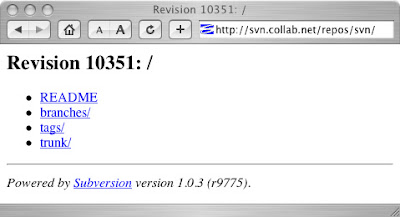
First, you can point any web browser to your Subversion repository and navigate your way through the latest revision of your repository.
Second, if you're using an operating system that knows how to talk to DAV shares, you can mount your Subversion repository (read-only) on your desktop:

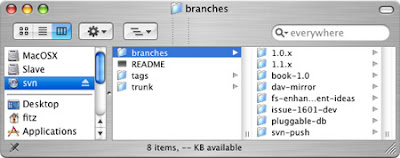
While this is a convenient way to see the contents of your repository, it's also very useful for sharing files with non-Subversion users.
Copyright © 2004 Brian W. Fitzpatrick, Ben Collins-Sussman, C. Michael Pilato. This article is distributed under the Creative Commons Attribution License (v 2.0).
The primary mission of the Subversion project is to "provide a compelling replacement for CVS." One of its secondary missions is to provide a user interface similar to CVS's, so that switching to Subversion will be painless for CVS users.
So, if you learn Subversion's new features, you're ready to start using it, right?
Almost. Although the interfaces are similar, there are some important differences. Subversion has some features that CVS either lacks or offers differently; plus, there's the need to unlearn some of the bad habits that CVS has instilled in you.
With that, I give you the top ten Subversion tips for CVS users. The first six tips address bad CVS habits; the last four address good Subversion habits.
1. Use status to find out your ... status
In CVS, if you want to see what has changed in your working copy, odds are that you run
cvs update. This command shows you the status of the files in your working copy, but it also updates your CVS working copy to the latest revision of the repository*. This not only requires a round-trip to the server, but also may change files in your working copy. Finding out what you've changed locally is different from finding out what has changed in the repository, but CVS mixes the two.**With Subversion, if you want to find out what you've modified, you run
svn status. This command compares the files in your working copy with those in the Subversion administrative areas (those pesky .svn directories), thus avoiding the necessity of a network round-trip:
  $ svn status
  D      fish.c
  A      shrimp.c
  M      anemone.c
Note that
fish.c is scheduled for deletion, shrimp.c is scheduled for addition, and anemone.c has been modified.Now, by default,
svn status shows only the files that are interesting (like those that have been added, modified, or deleted). If you want to see information about all the files in your working copy, pass the --verbose switch:
  $ svn status --verbose
                  44        23    sally     README
                  44        30    sally     INSTALL
                  44        35    harry     trout.c
  D               44        19    ira       fish.c
  A                0         ?     ?        shrimp.c
  M                0         ?     ?        anemone.c
                  44        36    harry     things/rocks.txt
The first column remains the same, but the second shows the working revision of the item. The third and fourth columns show the revision in which the item last changed, and who changed it.
If you want to know which files will be updated the next time you run
svn update, use the --show-updates switch to svn status:
  $ svn status --show-updates --verbose
         *        44        23    sally     README
                  44        30    sally     INSTALL
         *        44        35    harry     trout.c
  D               44        19    ira       fish.c
  A                0         ?     ?        shrimp.c
  M      *        44        32    sally     anemone.c
                  44        36    harry     things/rocks.txt
You can see that the files that will be updated are marked with a
*.* Unless you pass CVS the -n switch.
** CVS has a
status command, but it's not very useful.2. Remember, you can move things around
I've seen people spend hours in meetings working out the directory structure and file placement of a project they are preparing to create in their CVS repository--and anyone who's ever tried to move a directory or a file in CVS knows why: CVS doesn't allow you to move anything around in the repository!* With Subversion, you can move files and directories with wild abandon:
  $ svn move foo.c bar.c
  A         bar.c
  D         foo.c
Now
bar.c has been scheduled to be added and foo.c has been scheduled for deletion. (This is how Subversion represents a move.svn commit will send your changes to the server.)You can even move files and directories on the server by using URLs:
  $ svn move -m "Move a file" http://svn.red-bean.com/repos/foo.c \
                              http://svn.red-bean.com/repos/bar.c
That will immediately move
foo.c to bar.c on the server. * Unless, of course, you shell into your repository and start moving and copying things around by hand, but this totally hoses your repository history.
3. Tag and branch by copying
In CVS, you have
cvs tag, cvs tag -b, cvs rtag, and cvs rtag -b for creating tags and branches. In Subversion, everything is done as a copy:
  $ svn copy -m "Tag rc1 rel." http://svn.red-bean.com/repos/trunk \
                               http://svn.red-bean.com/repos/tags/1.0rc1
You've created a tag of your main line of development (referred to as
trunk in Subversion terms). If you want to create a branch instead, copy the trunk line of development into the branches directory--it's just that easy. And in Subversion, tagging and branching are fast too. In Subversion, tags and branches are just copied paths in the repository tree. By convention, tags live under
/tags and branches live under /branches.CVS has to modify each individual file that you tag in the repository; depending on the size of your repository, this could take a very long time. Subversion, on the other hand, needs only to copy a single directory node, which not only is really fast but also takes very little space in your repository--no matter how many files are involved in the branch or tag. The Subversion community calls 'em "cheap copies" for good reason!
You're not limited to tagging all files in the same revision in Subversion: If you need to make a "mixed-revision" tag or branch, you can always copy a working copy to a URL:
$ svn copy -m "Mixed branch." . http://svn.red-bean.com/repos/branch/1.2-mixed
See Branching and Merging for an extensive description of how to branch and tag.
4. "Revert" instead of "delete and update"
If you've ever made changes to a file in your CVS working copy that you wanted to undo without committing, you probably did something like this to rectify the situation:
  $ rm I-made-a-boo-boo.txt
  $ cvs up I-made-a-boo-boo.txt
  U  I-made-a-boo-boo.txt
And that, aside from requiring two separate operations, required a trip to the server to get the unblemished file (which, by the way, may not be the original file you were working on but rather a newer version). Subversion, however, stores a pristine copy of each file in the
.svn directory, so you can just do this:
  $ svn revert I-made-a-boo-boo.txt
  Reverted 'I-made-a-boo-boo.txt'
That comes in especially handy if you don't have a Net connection at the time.
5. Don't fear your version control system
By default, CVS translates line endings (from CR [Unix] to CRLF [Windows] and back) and expands keywords (like $Id$) in your files. This is very handy until you commit a binary file to your CVS repository and CVS, in a fit of helpfulness, turns your file into tapioca pudding.
Subversion will never ever ever do anything to your data unless you ask it to.
Let's say that together now:
SUBVERSION WILL NEVER EVER EVER DO ANYTHING TO YOUR DATA UNLESS YOU ASK IT TO.
You can add any binary file to your Subversion repository and not have to do anything special to have Subversion not destroy your file. However, if you add a text file (a .java file or .c file, for example), you may want Subversion to automatically handle end-of-line translation for you. This is done using Subversion properties.
In this case, you will set the
svn:eol-style property to native:
$ svn propset svn:eol-style native halibut.c
and then commit your change.
You can teach your Subversion client to add certain properties to your files automatically--see the section on Automatic Properties and their configuration for more information.
6. Log, log, log your log
Subversion's
log command is so much more powerful than CVS log that it merits a mention.Part of the reason Subversion's log command gives more useful and compact data is that its output is based on an atomic Subversion commit rather than a collection of files that may or may not be part of the same commit. (Keep in mind that CVS has no actual concept of a commit grouping.) So Subversion is able to show you a much more concise view of your repository's log data.
For example:
  $ svn log
  ------------------------------------------------------------------------
  r3 | sally | Mon, 15 Jul 2002 18:03:46 -0500 | 1 line

  Added include lines and corrected # of cheese slices.
  ------------------------------------------------------------------------
  r2 | harry | Mon, 15 Jul 2002 17:47:57 -0500 | 1 line

  Outline sandwich fixins.
  ------------------------------------------------------------------------
  r1 | sally | Mon, 15 Jul 2002 17:40:08 -0500 | 1 line

  Initial import
  ------------------------------------------------------------------------
Each log entry shows you the revision number of the entry, the author, the date, the number of lines in the log entry (to aid in parsing
svn log's output), and then the log message itself. If you wish to see the paths that changed in your log output, pass the --verbose flag: $ svn log --verbose
------------------------------------------------------------------------
r3 | sally | Mon, 15 Jul 2002 18:03:46 -0500 | 1 line
Changed paths:
M /trunk/sandwich.txt
Added include lines and corrected # of cheese slices.
------------------------------------------------------------------------
r2 | harry | Mon, 15 Jul 2002 17:47:57 -0500 | 1 line
Changed paths:
M /trunk/sandwich.txt
Outline sandwich fixins.
------------------------------------------------------------------------
r1 | sally | Mon, 15 Jul 2002 17:40:08 -0500 | 1 line
Changed paths:
A /trunk/sandwich.txt
Initial import
------------------------------------------------------------------------
In the above examples, you might have noticed that we're not passing any specific files or directories (called
targets) to the log command. If you run svn log without specifying any targets, Subversion assumes that you're referring to your current working directory. Subversion then uses a starting revision of 1, and the working revision of your current working directory as the ending revision. (You can find out what this working revision is by using svn status -v, as we mentioned earlier.) And now on to a small gotcha: If you commit a change to a file and immediately run
svn log, you won't see the log message for your most recent commit. This is because the "working revision" of your working directory has not been updated (committing a file does not automatically update your working directory or any other files). If you run svn update and then svn log, you'll see the "missing" log message. See http://svnbook.red-bean.com/svnbook/ch03s06.html#svn-ch-3-sect-5.1 and http://svnbook.red-bean.com/svnbook/re15.html for more information on using
svn log.7. Quickly undo a mistaken commit
Suppose you have a working copy of /trunk and discover that the change you made in revision 303, which changed
oyster.c, is completely wrong--it never should have been committed. You can use svn merge to "undo" the change in your working copy*, and then commit the local modification to the repository. All you need to do is specify a reverse difference using svn merge:
  $ svn merge -r 303:302 http://svn.example.com/repos/calc/trunk
  U  oyster.c
Use
svn diff to verify that the change is correct, and then commit that to the repository.For more information, see Undoing Changes.
* That is, restore the latest revision of your repository to its previous state; Subversion will still have the "bad" commit in the repository. Being a version control system, Subversion's job is to remember everything you've ever committed to it.
8. Resurrect deleted items
If you delete a file from your Subversion repository and wish to "resurrect" it into the latest revision of your repository, the easiest way is to
svn copy it from a revision before it was deleted into your working copy. Use svn log -v to find the revision where the file was deleted, and then do your copy:
 $ svn copy --revision 807 \
              http://svn.red-bean.com/repos/trunk/perch.c ./perch.c
For more details, see Resurrecting deleted items.
9. Switch to a branch without checking out a new working copy
In CVS, if you have a working copy for your project and are ready to begin work on a branch, you would pass the branch name as the revision to which you wished to update. Because Subversion treats tags and branches as regular paths in the repository, you can't just
svn update your working copy to the branch name in question. Enter the svn switch command.svn switch updates your working copy to mirror a new tree in the repository--say, a branch tree instead of the trunk tree. This is the Subversion way to move a working copy to a new branch.
  $ svn switch http://svn.red-bean.com/repos/branches/vendors-with-fix .
  U  myproj/foo.txt
  U  myproj/bar.txt
  U  myproj/baz.c
  U  myproj/qux.c
  Updated to revision 31.
For more details, see Switching a working copy.
10. Browse or even mount your repository
If your Subversion repository is being served up through the Apache HTTP Server (that is, you access it via a URL beginning with
http), Subversion gives you a couple of extremely convenient freebies:First, you can point any web browser to your Subversion repository and navigate your way through the latest revision of your repository.

Second, if you're using an operating system that knows how to talk to DAV shares, you can mount your Subversion repository (read-only) on your desktop:


While this is a convenient way to see the contents of your repository, it's also very useful for sharing files with non-Subversion users.
Copyright © 2004 Brian W. Fitzpatrick, Ben Collins-Sussman, C. Michael Pilato. This article is distributed under the Creative Commons Attribution License (v 2.0).
Feb 28, 2007
The Plane Truth, London Heathrow
[This was originally written on 2 July, 2003. Still catching up...]
This isn't a plane truth story in the sense that I sat next to someone famous, interesting, or with 2 left arms and a martian finger growing out of her forehead. This is a story of a month of insane travel, sleep deprivation, and how I got home at the end of it.
June was a bit of a crazy month for me. I finished May by doing a three day tour of Ontario CA, Newark NJ, and Lincoln NE. June started with a week in Atlanta, a week at home, a week in Cupertino, 3 days in Santa Cruz, and a week in San Francisco for WWDC. I ended up leaving WWDC with a Friday flight that landed in Chicago at 6:00PM, allowing me 13 hours to get home, unpack, wash my clothes, pack, and get back to the airport for a 9:00AM flight to Heathrow. Joy.
Mind you, I slept in my own bed for a grand total of 6 nights in the month of June. That is to say: I didn't sleep very well at all. I can sleep just about anwhere, but hotel beds may as well be made of scrap iron and watchsprings for all I can sleep in them. So a big fat 8 hour time shift is just what I needed to help me sleep at night. Hellooooooooo jet-lag.
And thus begins my story:
I get into London at about 10:30PM and into my hotel at about midnight (the hotel is near Apple's office about 3 miles from Heathrow, which becomes rather important later in the story).
I spend Sunday wandering around downtown London trying to stay awake and soak up the sunshine to help kill my jet lag as I have 2 long days ahead of me where I have to train a bunch of people from Apple Europe. Nothing inhibits sensical lecturing like massive jet lag and a serious lack of sleep.
Monday is my first day of training. Even after a pot of tea and 3 cups of coffee, I still feel like I'm talking through a mouth full of novocaine. My veins are full of warm caramel. Everything moves in slow motion. Charlie Brown's teacher sounds like JFK next to me.
Tuesday I finally start to really get into the sleep deprivation thing and hit my stride at about 2:30 in the afternoon--a full hour before my class ends and 21 hours before the return flight home. Perfect.
Tuesday night I go over to a friends place in London for dinner. He cooks a *phenomenal* dinner which consists of a profound amount of homemade Indian food, great dessert and a couple of tasty BudVar "Budweiser" beers. Stuffed full and well past exhausted I get back to my hotel at around 11:45.
I have every intent of packing and getting totally ready so that in the morning I can just shower, get dressed, have a nice leisurely breakfast, and make my way to the airport with plenty of time to spare. You may recall that the road to hell is paved with good intentions.
I decide I might as well watch some TV before packing, so I sit down on the bed in my clothes, but not before setting my alarm for 6:30 AM just in case I somehow pass out while watching TV.
My flight to Chicago is at 10:30AM the next day. This, like the location of my hotel, is also a rather important detail.
I double check my travel alarm to make sure it's set correctly. I set the alarm clock on the desk across the room as I'm famous for beating on any alarm clock within arm's length and falling back asleep (instead of getting up, gaining consciousness, turning it off, and going about my day).
I settle in for a little late-night British television and manage to watch about 15 seconds worth before falling soundly asleep.
Packing just isn't going to happen tonight.
I have a very vague memory of waking up, looking at the LED clock on the television, acknowledging that it's 2:00AM, brushing my teeth, taking my jeans and Apple shirt off, putting on a T-shirt, and climbing back to bed. I leave the television on for company.
I wake up on my own accord (no big surprise there) and try to fall back asleep with no luck. I roll over and watch a little television, and as my eyes began to focus, I try to make out the clock on the television. It says
9:09
*blink*
9:09
I get up, walk across the room, bend down and look at the clock so closely that it fills my field of vision.
9:09
I look at my alarm clock to make sure the television hasn't gone haywire. It too reads
9:09
And the alarm had somehow been turned off.
Babies don't sleep this well.
"OK," I tell myself, "Don't panic, we can work this out. We'll make the flight."
I think about it for a moment, and then decide to give myself 30 seconds to panic.
I panic, and then I spring into action. In that 30 seconds of panic, my body dumps every available gram (not ounces--remember, they use the metric system in the UK) of adrenalin into my bloodstream. I become as focused as a laser beam. I see through walls. I have A Plan.
So I made my flight after all, and with plenty of time to spare. I slept through takeoff, landing, and most of the next day.
And that's the plane truth.
"If you haven't missed at least one flight in the last year, you're getting to the airport too early."
--Steve Hayman
This isn't a plane truth story in the sense that I sat next to someone famous, interesting, or with 2 left arms and a martian finger growing out of her forehead. This is a story of a month of insane travel, sleep deprivation, and how I got home at the end of it.
June was a bit of a crazy month for me. I finished May by doing a three day tour of Ontario CA, Newark NJ, and Lincoln NE. June started with a week in Atlanta, a week at home, a week in Cupertino, 3 days in Santa Cruz, and a week in San Francisco for WWDC. I ended up leaving WWDC with a Friday flight that landed in Chicago at 6:00PM, allowing me 13 hours to get home, unpack, wash my clothes, pack, and get back to the airport for a 9:00AM flight to Heathrow. Joy.
Mind you, I slept in my own bed for a grand total of 6 nights in the month of June. That is to say: I didn't sleep very well at all. I can sleep just about anwhere, but hotel beds may as well be made of scrap iron and watchsprings for all I can sleep in them. So a big fat 8 hour time shift is just what I needed to help me sleep at night. Hellooooooooo jet-lag.
And thus begins my story:
Total amount of sleep Friday night: 4 hours
I get into London at about 10:30PM and into my hotel at about midnight (the hotel is near Apple's office about 3 miles from Heathrow, which becomes rather important later in the story).
Total amount of sleep Saturday night: 3 hours
I spend Sunday wandering around downtown London trying to stay awake and soak up the sunshine to help kill my jet lag as I have 2 long days ahead of me where I have to train a bunch of people from Apple Europe. Nothing inhibits sensical lecturing like massive jet lag and a serious lack of sleep.
Total amount of sleep Sunday night: 5 hours
Monday is my first day of training. Even after a pot of tea and 3 cups of coffee, I still feel like I'm talking through a mouth full of novocaine. My veins are full of warm caramel. Everything moves in slow motion. Charlie Brown's teacher sounds like JFK next to me.
Total amount of sleep Monday night: 2 hours, 30 minutes
Tuesday I finally start to really get into the sleep deprivation thing and hit my stride at about 2:30 in the afternoon--a full hour before my class ends and 21 hours before the return flight home. Perfect.
Tuesday night I go over to a friends place in London for dinner. He cooks a *phenomenal* dinner which consists of a profound amount of homemade Indian food, great dessert and a couple of tasty BudVar "Budweiser" beers. Stuffed full and well past exhausted I get back to my hotel at around 11:45.
I have every intent of packing and getting totally ready so that in the morning I can just shower, get dressed, have a nice leisurely breakfast, and make my way to the airport with plenty of time to spare. You may recall that the road to hell is paved with good intentions.
I decide I might as well watch some TV before packing, so I sit down on the bed in my clothes, but not before setting my alarm for 6:30 AM just in case I somehow pass out while watching TV.
My flight to Chicago is at 10:30AM the next day. This, like the location of my hotel, is also a rather important detail.
I double check my travel alarm to make sure it's set correctly. I set the alarm clock on the desk across the room as I'm famous for beating on any alarm clock within arm's length and falling back asleep (instead of getting up, gaining consciousness, turning it off, and going about my day).
I settle in for a little late-night British television and manage to watch about 15 seconds worth before falling soundly asleep.
Packing just isn't going to happen tonight.
I have a very vague memory of waking up, looking at the LED clock on the television, acknowledging that it's 2:00AM, brushing my teeth, taking my jeans and Apple shirt off, putting on a T-shirt, and climbing back to bed. I leave the television on for company.
I wake up on my own accord (no big surprise there) and try to fall back asleep with no luck. I roll over and watch a little television, and as my eyes began to focus, I try to make out the clock on the television. It says
9:09
*blink*
9:09
I get up, walk across the room, bend down and look at the clock so closely that it fills my field of vision.
9:09
I look at my alarm clock to make sure the television hasn't gone haywire. It too reads
9:09
And the alarm had somehow been turned off.
Total amount of sleep Tuesday night: 9 hours, 9 minutes.
Babies don't sleep this well.
"OK," I tell myself, "Don't panic, we can work this out. We'll make the flight."
I think about it for a moment, and then decide to give myself 30 seconds to panic.
I panic, and then I spring into action. In that 30 seconds of panic, my body dumps every available gram (not ounces--remember, they use the metric system in the UK) of adrenalin into my bloodstream. I become as focused as a laser beam. I see through walls. I have A Plan.
- 9:10
- Call the hotel front desk. Order a cab:
"I'd like to order a Taxi to Heathrow, please" "And when would you like it, Mr. Fitzpatrick?" Thinking "An hour ago.", I reply "In 10 minutes."
- 9:11
- Brush my teeth, wash my face, apply a double helping of deoderant, get dressed into the same clothes I was wearing yesterday, and put on my Cubs hat.
- 9:15
- Rip the bedspread off the bed and use the bed as a staging area: put my roll-aboard and my laptop bag on it and start throwing all of my stuff (which is of course scattered all over the room) onto the bed.
- 9:17
- Start packing my bags. Jam everything in. Jump on the bag to help it zip. Zip my fingertip into the bag. Swear loudly.
- 9:19
- Leave the room.
- 9:21
- Checkout and pay the bill at the front desk.
- 9:24
- Exit the hotel to discover the taxi waiting for me. Excellent. I explain my plight to the cab driver who narrowly misses running over 4 pedestrians trying to get me to the airport as quickly as possible. I Remember to tip this guy well.
- 9:33
- Arrive at Terminal 3 and spot the American Airlines curbside checkin. Pay cab, sprint to checkin and fumble my passport at the clerk.
"I'm on the 10:30 flight to Chicago."
Clerk looks at her watch. Clerk looks at me. Clerk blinks loudly.
"I don't have any bags to check."
Clerk makes "Ahhh" look, takes my passport, checks me in, gives me my boarding pass, my passport, and a handful of cryptic directions to the security checkpoint. - 9:34
- Done with checkin. 45 seconds flat.
- 9:36
- Get in queue (no lines over here--just queues) for the security checkpoint.
- 9:41
- Set off the buzzer as I pass through the metal detector. Get patted down by a guard who enjoyed it a bit more than etiquette dictates he should.
- 9:42
- Reward myself by browsing the duty free stores for the next 15 minutes.
- 9:57
- Walk to my gate.
- 10:02
- Arrive at my gate and wait in line.
- 10:09
- Step foot onto the plane, exactly 1 hour after waking up.
So I made my flight after all, and with plenty of time to spare. I slept through takeoff, landing, and most of the next day.
And that's the plane truth.
Feb 27, 2007
Customer Service Take 2
[This was originally written on 10 July, 2002. Still catching up...]
After my delightful experience with Griffin
Technology, I'm well on my way to a hat trick considering
this exchange with SmartDisk. This is
another example of what an individual can do to make their
company look great (at least in my eyes).
I'll let the emails tell the story...
And Ian responded:
And I responded...
...and back to Ian...
...and back to me...
...and back to Ian one last time.
Thanks again Ian.
After my delightful experience with Griffin
Technology, I'm well on my way to a hat trick considering
this exchange with SmartDisk. This is
another example of what an individual can do to make their
company look great (at least in my eyes).
I'll let the emails tell the story...
   From: B. W. Fitzpatrick <fitz@apple.com>
   To: SmartDisk Technical Support
   Date: Tue Jul 30, 2002
   Subject: Problems with 3GB Firewire Pocket Drive
   --------------------------------------------------------

   This drive worked fine for the first year I had it, then
   started giving problems. Whenever I would attempt to read or
   write a certain file, it would hang the Finder. I upgraded the
   firmware to the latest (using the VST 2.3.1 Format Utility). I
   did a low-level format. I reformatted again.

   I talked nicely to the drive and explained that my job was to
   put files on it and that its job was to keep those files and
   return them to me on demand.  I took it to the zoo to see the
   animals. I even took it shopping in the hopes that that would
   cheer it up.

   However, the drive still has not seen the light and will work
   fine reading and writing until a certain point, at which I get
   the Spinning Pizza of Death and the Finder locks up. I bought
   this drive about 2 years ago.  Please tell me you can replace
   it or convince it to do what its supposed to do.

   -Fitz
And Ian responded:
   From: Ian
   Date: Tue Jul 30, 2002
   To: "B. W. Fitzpatrick" <fitz@apple.com>
   Subject: Case # 15686
   --------------------------------------------------------

   Hello Brian, thanks for contacting us. I thoroughly enjoyed
   reading about your relationship with the drive, although it
   does seem like the sparks between you two are dying. So
   sad.

   Unfortunately it sounds as though the hard drive mechanism
   itself is starting to die. It doesnt sound like an extension
   or software problem.  The only real solution is to replace
   the hard drive mechanism which sits on the firewire
   interface board. We do not do out of warranty repairs so you
   will need to do this yourself or take it to a repair
   center. It uses a standard laptop size IDE hard
   drive. Please let me know if I can be of further
   assistance.

   Ian
     SmartDisk Corporation Technical Support
And I responded...
   From: B. W. Fitzpatrick <fitz@apple.com>
   Date: Tue, Jul 30, 2002
   To: Ian
   Subject: Re: Case # 15686
   --------------------------------------------------------

   What is the warranty on the drive? I take it it's less than
   2 years?.

   -Fitz

   PS, One of my friends here suggested that Firewire drives
   prefer the beach, so I'm guessing the zoo thing didn't
   help.

   ;-)
...and back to Ian...
   From: Ian
   Date: Wed Jul 31, 2002
   To: "B. W. Fitzpatrick" <fitz@apple.com>
   Subject: RE: Case # 15686
   --------------------------------------------------------

   LOL

   The warranty is 1 year from the purchase date. If the
   drive is out of warranty, I might recommend contacting
   Huong <name removed>, (pronounced like Hong.)  She
   can be reached at 978-555-1212, her e-mail is, <address
   removed>. She works at Teleplan International which we
   have given our blessing to do out of warranty repair
   work. Please let me know if I can be of further
   assistance.

   Ian

   PS Maybe if you took the drive to a Robot Wars showing
   you could intimidate the drive into working. :P
...and back to me...
   From: B. W. Fitzpatrick <fitz@apple.com>
   Date: Wed Jul 31, 2002
   To: Ian
   Subject: RE: Case # 15686
   --------------------------------------------------------

   Ian,

   Thanks a million for your replies. It's always nice to find
   a human being behind a big company.

   >  PS Maybe if you took the drive to a Robot Wars showing
   >    you could intimidate the drive into working. :P


   Alas, I fear that it's time to retire the drive to that great
   bitbucket in the sky. Perhaps it would make a good projectile for one
   of the other robots.

       :-)

   Take care,

       -Fitz
...and back to Ian one last time.
   From: Ian
   Date: Wed Jul 31, 2002
   To: "B. W. Fitzpatrick" <fitz@apple.com>
   Subject: RE: Case # 15686
   --------------------------------------------------------

   It's nice to have a customer that is understanding and
   competent!

   Before you off up the drive as a sacrifice to the Great
   Bitbin, I would suggest opening the drive up by taking the
   plastic casing off. If you hold it under a heat lamp (or a
   blow dryer) the glue will heat up and you can take the
   plastic casing off. There will be 4 screws that hold the
   case together (very easy) and then you will see the Firewire
   interface board and the IDE hard drive. It really is a
   simple design, which is great. You can definately put 30 gig
   hard drive on the board (I am unsure of anything higher, but
   I would imagine you could). The interface card is really the
   expensive piece to the device and you can use any brand of
   hard drive on the card. So I guess what I am saying is, I
   would suggest at least taking the drive apart. You could
   even get a cheapo drive from ebay. I know you probably paid
   a hefty price for the drive and I would hate to see it
   turned into robot projectiles after 2 years. If you have any
   questions during the process, please feel free to ask!

   Ian
Thanks again Ian.
Feb 22, 2007
Dear Craigslist Seller...
Dear Craigslist Seller who sold me your used DirecTV Tivo,
I feel that it is my duty to share with you a few tips on selling a used Tivo:
1. You should really reset your Tivo before selling it. Since you neglected to do that, I got to peruse your fascinating choice of Oprah episodes and Adam Sandler movies. Cute.
2. While I greatly appreciate the $25 you saved me by including the access card in the Tivo, for future reference, your purchase history is stored on this card, and no amount of Tivo resetting will clear out these purchases, so I'll get to see just what your taste in soft porn is. Just in case you've forgotten, here's your purchase history:
Added 2 April, 2007:
Dear Time Warner: Looks like you could use some help too.
I feel that it is my duty to share with you a few tips on selling a used Tivo:
1. You should really reset your Tivo before selling it. Since you neglected to do that, I got to peruse your fascinating choice of Oprah episodes and Adam Sandler movies. Cute.
2. While I greatly appreciate the $25 you saved me by including the access card in the Tivo, for future reference, your purchase history is stored on this card, and no amount of Tivo resetting will clear out these purchases, so I'll get to see just what your taste in soft porn is. Just in case you've forgotten, here's your purchase history:
- Amateur Strip Night: Bare it All ($14.95), purchased Sun, 7/17/2005 @ 3:00PM
- Boxing: Gatti vs. Mayweather - Live ($44.95), purchased Sat, 6/25/2005 @ 8:00PM
- Hot Body: Booty Camp ($4.99), purchased Thurs, 3/3/2005 @ 2:00PM
- Voyeur Vol. 1 ($4.99), purchased Thurs, 3/3/2005 @ 12:30PM
Added 2 April, 2007:
Dear Time Warner: Looks like you could use some help too.
Feb 21, 2007
Pop Olympics
[This was originally written on 21 February, 2002. Still catching up...]
Ever since I was a kid I've loved the Olympics. I can remember camping out in front of the television years ago and watching them for hour after hour, from the opening ceremony to the close, like some out-of-control Jerry Lewis telethon. It all seemed so magical--the excitement of the events, the highs of the medal ceremonies... the anticipation alone warmed the cockles of my (even then) couch potato heart.
Even now I love to watch the Olympics. Those of you who know me are probably wondering "Who the hell is writing this crap?" Yes, for the most part I'm not interested in sports, but for some reason I could sit down for days on end and watch skiing, bobsled, skating, and yes, even curling. And I have to confess that I love the figure skating. Something about the Olympics just turns me into a blubbering sap. So shoot me.
I don't know what it is--There's just something about watching these massively dedicated people pit themselves against each other and the clock that fascinates me. And that single moment when an athlete wins the gold medal makes me go all mushy and rubbery inside. I get this sympathetic emotional charge coursing through my body as though I was actually there.
But here's the kicker. I want to watch the events. I mean all the events. I want to see Austria vs. Canada in curling. I want to see Italy match up against Mexico in the frozen cow-chip toss. I want to see Burkina Faso take on Martinique in the two-man three-legged cross-country dodeca-athlon. I want to see the Olympics.
Instead, I get to watch Bob Costas trying (and failing spectacularly) to be funny. I get to watch the Daytona 500. I get to watch vapid hollywood gossip shows. And God forbid we preempt a soap opera for something as boring as the Olympics.
Aside from the sparse coverage on MSNBC and CNBC, I get 3 hours of commercial-packed Olympics at prime-time from 7 to 10 each night. And if that's not bad enough, an hour of that is taken up following American athletes around asking stupid questions like "Are you going to try for the gold?", "Are you excited to be here?" etc.
You've gotta be kidding me.
We get to see the American athletes competing for their medals. Condensed, tape-delayed snippets of various events, sanitized and liberally sprinkled with background and local-color segments are spoon fed to us, Nielsen point by Nielsen point. If an alien dropped into my living room and watched the Olympics as presented on NBC, they'd think it was the USA against a bunch of other mouth-breathers who just happened to luck out and win an event once in a while.
Now I understand that NBC needs to make money off the Olympics, and I don't begrudge them that--I'm well aware of the world that we live in. But come on, NBC should be ashamed of itself. They complained two years ago when the Summer Olympics was in Australia that the huge time difference was going to reduce viewership because they couldn't show events live at 4AM. But this year, with no time difference at all, we get to watch our events tape-delayed (and edited down). This kind of behavior is below even an Enron executive (OK, maybe not, but you get my point).
Let's set the way-back machine for summer 2000. I spent the entire duration of the Summer Games working at a client in Switzerland (Believe me, it's not always this good). And I'll bet you that I saw more of the Olympics than anyone in the US did that year. There was a channel called Eurosport that showed the Olympics 24 hours a day. They showed live Olympic events all night long, and when the Olympic day ended, they showed the rest of the events that happened that day, interspersed with reruns of the live events. Maybe they would squeeze in a medal ceremony if there was time. Commercials were short and painless, and we didn't get to hear from Jane Swimmer's aunt's gardener's cousin's wife about how Jane wanted to be a swimmer ever since her mother dumped her into a drainage canal at the tender age of 2. I saw the Olympics that year.
So, for crying out loud, couldn't we sacrifice a cable channel somewhere to show the real olympics instead of this watered down drivel? I mean, can't we live for two weeks without the "Hairless Cat Channel," or the Infomercial channel or something? NBC can still show their version of the Olympics, but at least those of us who are interested would be able to watch the real Olympics.
Ever since I was a kid I've loved the Olympics. I can remember camping out in front of the television years ago and watching them for hour after hour, from the opening ceremony to the close, like some out-of-control Jerry Lewis telethon. It all seemed so magical--the excitement of the events, the highs of the medal ceremonies... the anticipation alone warmed the cockles of my (even then) couch potato heart.
Even now I love to watch the Olympics. Those of you who know me are probably wondering "Who the hell is writing this crap?" Yes, for the most part I'm not interested in sports, but for some reason I could sit down for days on end and watch skiing, bobsled, skating, and yes, even curling. And I have to confess that I love the figure skating. Something about the Olympics just turns me into a blubbering sap. So shoot me.
I don't know what it is--There's just something about watching these massively dedicated people pit themselves against each other and the clock that fascinates me. And that single moment when an athlete wins the gold medal makes me go all mushy and rubbery inside. I get this sympathetic emotional charge coursing through my body as though I was actually there.
But here's the kicker. I want to watch the events. I mean all the events. I want to see Austria vs. Canada in curling. I want to see Italy match up against Mexico in the frozen cow-chip toss. I want to see Burkina Faso take on Martinique in the two-man three-legged cross-country dodeca-athlon. I want to see the Olympics.
Instead, I get to watch Bob Costas trying (and failing spectacularly) to be funny. I get to watch the Daytona 500. I get to watch vapid hollywood gossip shows. And God forbid we preempt a soap opera for something as boring as the Olympics.
Aside from the sparse coverage on MSNBC and CNBC, I get 3 hours of commercial-packed Olympics at prime-time from 7 to 10 each night. And if that's not bad enough, an hour of that is taken up following American athletes around asking stupid questions like "Are you going to try for the gold?", "Are you excited to be here?" etc.
"No, I'm bummed to be here and I'm really hoping to walk away with the zinc medal. My motto is 'strive for mediocrity', Bob."
You've gotta be kidding me.
We get to see the American athletes competing for their medals. Condensed, tape-delayed snippets of various events, sanitized and liberally sprinkled with background and local-color segments are spoon fed to us, Nielsen point by Nielsen point. If an alien dropped into my living room and watched the Olympics as presented on NBC, they'd think it was the USA against a bunch of other mouth-breathers who just happened to luck out and win an event once in a while.
Now I understand that NBC needs to make money off the Olympics, and I don't begrudge them that--I'm well aware of the world that we live in. But come on, NBC should be ashamed of itself. They complained two years ago when the Summer Olympics was in Australia that the huge time difference was going to reduce viewership because they couldn't show events live at 4AM. But this year, with no time difference at all, we get to watch our events tape-delayed (and edited down). This kind of behavior is below even an Enron executive (OK, maybe not, but you get my point).
Let's set the way-back machine for summer 2000. I spent the entire duration of the Summer Games working at a client in Switzerland (Believe me, it's not always this good). And I'll bet you that I saw more of the Olympics than anyone in the US did that year. There was a channel called Eurosport that showed the Olympics 24 hours a day. They showed live Olympic events all night long, and when the Olympic day ended, they showed the rest of the events that happened that day, interspersed with reruns of the live events. Maybe they would squeeze in a medal ceremony if there was time. Commercials were short and painless, and we didn't get to hear from Jane Swimmer's aunt's gardener's cousin's wife about how Jane wanted to be a swimmer ever since her mother dumped her into a drainage canal at the tender age of 2. I saw the Olympics that year.
So, for crying out loud, couldn't we sacrifice a cable channel somewhere to show the real olympics instead of this watered down drivel? I mean, can't we live for two weeks without the "Hairless Cat Channel," or the Infomercial channel or something? NBC can still show their version of the Olympics, but at least those of us who are interested would be able to watch the real Olympics.
Feb 19, 2007
Customer Service is Not Dead
[This is the second post in a series that I'm doing just to get some old stuff that I wrote up onto my blog. This was originally posted 25 October, 2001, and I still think happy thoughts when someone mentions Griffin.]
Although I've thought for years that customer service in the technology industry was dead, I recently discovered that it's alive and well and spending its afternoons over at Griffin Technology
I've had an iMate USB to ADB converter for almost 2 years now. I use it at work with my Maltron keyboard (which doesn't have a USB model). Not only do I use it with my desktop, but I take this keyboard (and the adaptor) with me on the road with me from 5 to 15 weeks a year, so they get abused regularly.
The other day, in the process of trying to reseat a loose wire in the iMate, I ripped two of the four wires right off the solder pads in the dongle. At first try to fix, I soldered the wires on backwards, so I decided to see if I could get a hold of someone at Griffin before I completely cooked the thing.
I went to their website. I found a phone number to call in less than 30 seconds.
I called the phone number. A human being answered on the third ring.
A human being answered the phone. On the third ring.
He introduced himself as Vance. I explained my dilemma and that I was trying to solder the iMate back together. Without flinching or chastising me about warranty violations, he asked me to hold for a second while he went to find another iMate. Less than a minute later he came back on the line. He cracked his iMate open and told me which wires went where. And then... and then, he told me that if I couldn't fix it to give them a ring and they would send me a new one.
*boggle*
Mind you, the one I have is almost 2 years old and I'm attacking it (rather ineptly) with a soldering iron. And he offered to replace it. Free.
In this day where you wind up in voicemail jail for 20 minutes just to get to some half-wit who can't even remember what products his company sells, this was, needless to say, immensely refreshing.
I told Vance that if I couldn't get it to work I would buy two of them from Griffin.
I did get it to work. I also bought a new iMate, just in case.
Although I've thought for years that customer service in the technology industry was dead, I recently discovered that it's alive and well and spending its afternoons over at Griffin Technology
I've had an iMate USB to ADB converter for almost 2 years now. I use it at work with my Maltron keyboard (which doesn't have a USB model). Not only do I use it with my desktop, but I take this keyboard (and the adaptor) with me on the road with me from 5 to 15 weeks a year, so they get abused regularly.

The other day, in the process of trying to reseat a loose wire in the iMate, I ripped two of the four wires right off the solder pads in the dongle. At first try to fix, I soldered the wires on backwards, so I decided to see if I could get a hold of someone at Griffin before I completely cooked the thing.
I went to their website. I found a phone number to call in less than 30 seconds.
I called the phone number. A human being answered on the third ring.
A human being answered the phone. On the third ring.
He introduced himself as Vance. I explained my dilemma and that I was trying to solder the iMate back together. Without flinching or chastising me about warranty violations, he asked me to hold for a second while he went to find another iMate. Less than a minute later he came back on the line. He cracked his iMate open and told me which wires went where. And then... and then, he told me that if I couldn't fix it to give them a ring and they would send me a new one.
*boggle*
Mind you, the one I have is almost 2 years old and I'm attacking it (rather ineptly) with a soldering iron. And he offered to replace it. Free.
In this day where you wind up in voicemail jail for 20 minutes just to get to some half-wit who can't even remember what products his company sells, this was, needless to say, immensely refreshing.
I told Vance that if I couldn't get it to work I would buy two of them from Griffin.
I did get it to work. I also bought a new iMate, just in case.
Subscribe to:
Posts (Atom)